

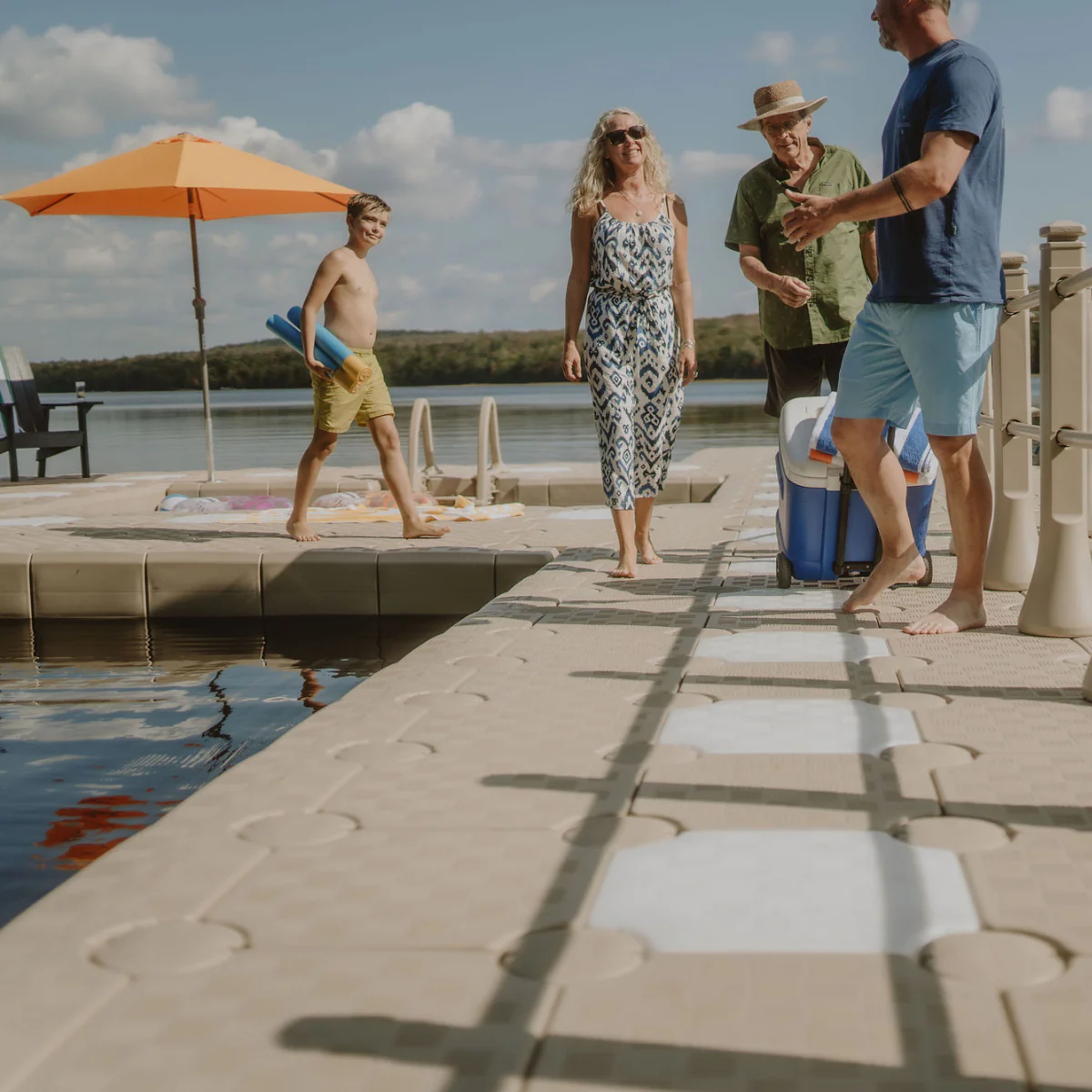
When choosing a dock for your waterfront property, one of the first decisions you’ll need to make is whether a floating dock or a traditional fixed dock is the better option.
Both types of docks have their advantages. A traditional dock can provide a familiar, solid structure, while a floating dock can offer greater flexibility, easier installation, and the ability to adapt to changing water levels and waterfront activities.
For homeowners looking for a modern, low-maintenance, and customizable solution, Candock’s modular floating dock system offers an alternative to conventional wood, aluminum, or concrete docks.
Floating Dock vs. Traditional Dock: What’s the Difference?
The main difference is how the dock interacts with the water.
A traditional fixed dock is generally supported by posts, pilings, or another permanent structure attached to the lake or river bottom. Its height and position remain relatively fixed.
A floating dock sits on buoyant modules and moves vertically with the water. This allows the dock to maintain a relatively consistent relationship with the water’s surface as water levels change.
Candock takes the floating dock concept further with a modular system made from interconnected components. The G2 Cube forms the foundation, allowing homeowners to create docks in different sizes and configurations.
Floating Dock vs. Traditional Dock: Quick Comparison
| Feature | Floating Dock | Traditional Fixed Dock |
|---|---|---|
| Adapts to changing water levels | Yes | Limited |
| Modular configuration | Yes | Usually limited |
| Easy to expand | Yes | Usually more difficult |
| Maintenance requirements | Very low with Candock | Depends on materials |
| Installation flexibility | High | Generally lower |
| Custom shapes | Yes | More complex |
| Easy to modify | Yes | Usually difficult |
| Winter removal | Possible depending on configuration | Depends on construction |
1. Floating Docks Adapt to Changing Water Levels
One of the biggest advantages of a floating dock is its ability to move with the water.
Water levels can change throughout the season because of rainfall, drought, snowmelt, water management, and other environmental factors. A floating dock follows these changes rather than remaining at a fixed elevation.
The Candock G2 Cube system is designed specifically as a floating modular platform, making it well suited to waterfront properties where water levels vary.
This can make entering and exiting boats, kayaks, and personal watercraft more convenient throughout the boating season.
2. Traditional Docks Can Offer a More Permanent Structure
Traditional fixed docks have been used for generations and remain a popular option for many waterfront properties.
A fixed dock can provide a solid, permanent-looking structure and may be appropriate for certain waterfront environments and applications.
However, because the structure is fixed relative to the bottom, changes in water level can alter the height of the dock above the water.
This is an important consideration for properties where seasonal water-level fluctuations are significant.
3. Floating Docks Are Easier to Customize
One of the biggest differences between a modular floating dock and a traditional dock is the ability to change the configuration.
With the Candock system, individual modules can be connected to create different layouts, including:
- Straight docks
- L-shaped docks
- T-shaped docks
- U-shaped docks
- Swimming platforms
- Boat access areas
- Custom waterfront configurations
The G2 Cube serves as the primary building block, while the G2 Corner Cube can be used to create corners, right-angle sections, and other configurations.
Explore the Candock G2 Corner Cube
This modular design means that you don’t necessarily have to determine the final configuration of your waterfront dock permanently on day one.
4. A Floating Dock Can Grow With Your Needs
Your waterfront activities may change over time.
You may start with a simple dock for swimming and fishing and later purchase a boat, jet ski, or kayak. With a traditional dock, accommodating these new activities can require significant modifications.
A modular floating dock provides more flexibility.
You can expand the dock, change its shape, or add specialized products as your needs evolve.
For example, a Candock configuration could combine:
- G2 Cubes for the main floating platform
- G2 Edge Cubes for a finished perimeter
- G2 Low Profile Cubes for easier kayak access
- JetSlide for personal watercraft
- JetRoll for drive-on jet ski storage
- Tiles Series for a more refined walking surface
5. Floating Docks Can Require Less Maintenance
Maintenance is another important factor when comparing dock systems.
Traditional wooden docks can require periodic staining, sealing, painting, sanding, or replacement of damaged boards. Aluminum docks may require different forms of maintenance depending on their construction and environment.
Candock’s floating dock system is made from high-density polyethylene (HDPE) and is designed to require virtually no structural maintenance.
The G2 Cube has an anti-skid surface and is designed to resist UV exposure, water, impacts, and various environmental conditions.
According to Candock, the dock itself requires essentially no maintenance beyond normal cleaning and ensuring that the cubes are not exposed to sharp objects that could damage them. :contentReference[oaicite:0]{index=0}
This can significantly reduce the amount of time spent maintaining your waterfront structure over the years.
6. A Modular Dock Can Be Easier to Repair
Another advantage of a modular floating dock is that the structure is made from individual components.
If a component is damaged, you don’t necessarily have to replace an entire dock section.
Individual G2 components can be replaced or rearranged as needed. Candock also allows certain accessories and components to be added later, providing additional flexibility throughout the life of the dock.
For example, G2 Edge Cubes can be added to an existing G2 dock, even years after the original installation. :contentReference[oaicite:1]{index=1}
This is particularly useful for homeowners who want to improve or modify their dock without starting from scratch.
7. Which Dock Is Better for Boats?
Both floating and traditional docks can work well for boats, but the best option depends on your waterfront and how you use your boat.
A Candock floating dock can provide a stable platform for boarding, swimming, fishing, and general boat access.
The G2 Edge Cube can also create a smoother perimeter where boats and personal watercraft can be moored alongside the dock.
Explore the Candock G2 Edge Cube
For homeowners looking for drive-on boat storage, Candock also offers dedicated Jetslide Boat Dry Dock systems designed for different boat sizes.
These systems can be incorporated into a broader floating dock configuration.
8. Which Dock Is Better for Jet Skis?
If you own a jet ski or personal watercraft, a modular floating dock provides the flexibility to integrate a dedicated docking system.
The JetSlide Jet Ski Dock and Ramp provides a convenient ramp-style solution for personal watercraft.
Another option is the JetRoll Drive-On Dock System, which is designed to make driving a personal watercraft onto and off the dock easier.
These specialized products can be combined with a larger Candock floating dock, allowing one waterfront system to accommodate multiple activities.
9. Which Dock Is Better for Kayaks?
Kayaks and canoes benefit from easy access to the water.
A floating dock can be configured specifically around this requirement.
The G2 Low Profile Cube provides a lower-profile option that can make accessing the water easier for smaller watercraft.
It can be incorporated into a larger configuration, allowing you to create one section of the dock specifically for kayak or canoe launching.
This can be particularly useful when your waterfront needs to accommodate both large and small watercraft.
10. Which Dock Looks Better?
Appearance is subjective, but modern floating docks can provide a clean and contemporary look.
Candock offers both beige and grey components, allowing homeowners to choose a finish that complements their waterfront property.
The G2 Edge Cube is specifically designed to create a cleaner and more finished perimeter around the dock, giving the system a more polished appearance.
For homeowners looking for an upgraded walking surface, the Tiles Series provides another option.
Explore the Candock Tiles Series
The Tiles Series combines a recycled plastic base with injected polypropylene tiles and provides a more solid walking surface than standard G2 cubes. It is also compatible with Candock’s LinQ accessories. :contentReference[oaicite:2]{index=2}
11. What About Installation?
Installation is another area where floating and traditional docks can differ significantly.
Traditional fixed docks can require posts, piles, concrete, or other structural components installed into or near the lakebed. Depending on the property, this can make installation more complex.
Candock’s modular system is designed for relatively straightforward assembly. The company recommends assembling dock sections on shore whenever possible and then moving the sections into the water to complete the installation. :contentReference[oaicite:3]{index=3}
This modular approach can make installation more manageable, particularly for residential waterfront projects.
12. What About Winter?
Winter conditions are an important consideration for Canadian waterfront properties.
In areas where lakes freeze, floating dock owners need to consider ice movement and spring thaw conditions.
Candock does not recommend leaving its docks in the water over winter. Some customers with calm waterfronts choose to do so, but the cubes are not guaranteed against ice damage. :contentReference[oaicite:4]{index=4}
For properties with significant ice movement, seasonal removal and storage should be considered when planning your dock.
Is a Floating Dock More Expensive Than a Traditional Dock?
The answer depends on the size, materials, configuration, installation method, and site conditions.
A simple traditional dock may have a lower initial purchase price in some situations, while a premium floating dock can represent a larger upfront investment.
However, the initial price is only one part of the equation.
When comparing dock systems, consider:
- Initial purchase cost
- Installation costs
- Anchoring requirements
- Annual maintenance
- Expected lifespan
- Ease of repair
- Ability to expand the dock
- Ability to change the configuration
- Winter storage requirements
Candock’s G2 Cube currently starts at approximately $44 CAD per square foot, before transportation and installation. Pricing is indicative and can vary depending on the final configuration and project requirements. :contentReference[oaicite:5]{index=5}
Floating Dock vs. Traditional Dock: Which One Should You Choose?
There is no single answer for every waterfront property.
A traditional fixed dock may be the right choice if you want a permanent structure and your waterfront conditions are well suited to a fixed installation.
A floating dock may be the better choice if you value flexibility, adaptability, easier modification, and a system that follows changing water levels.
For homeowners looking for a modular floating solution, Candock offers a range of products that can be adapted to different waterfront applications.
| Choose a Floating Dock If… | Choose a Traditional Dock If… |
|---|---|
| You want a modular system | You want a fixed structure |
| Your water level changes significantly | Your water level is relatively stable |
| You may want to expand the dock later | You don’t expect the configuration to change |
| You want low-maintenance materials | You prefer traditional construction |
| You want to accommodate multiple watercraft | Your waterfront has a simple, fixed purpose |
| You want a customizable configuration | A permanent dock meets all your needs |
Why Choose a Candock Floating Dock?
Candock’s modular floating dock system is designed around one central idea: your dock should be able to adapt to your waterfront and your lifestyle.
The G2 Cube provides the foundation, while products such as the G2 Corner Cube, G2 Edge Cube, G2 Low Profile Cube, and Tiles Series allow you to customize the layout and functionality.
For watercraft owners, products such as the JetSlide, JetRoll, and boat dry dock systems can be incorporated into the overall setup.
That means you can create a dock for swimming today and expand it into a complete waterfront system as your needs change.
The Bottom Line
When comparing a floating dock with a traditional dock, the best choice ultimately depends on your property, water conditions, budget, and long-term plans.
Traditional docks remain a proven solution for many waterfront properties, but modular floating docks offer a level of flexibility that can be difficult to achieve with a fixed structure.
For homeowners who want a dock that can adapt, expand, and accommodate different waterfront activities, a modular Candock system can be a practical alternative.
Ready to find the right dock for your waterfront property? Contact Candock Montreal to discuss your property, water conditions, preferred configuration, and the best floating dock solution for your needs.